
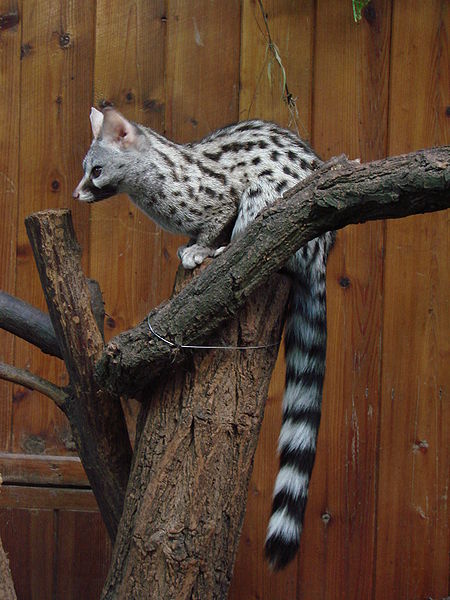
Did you know that there are real fake cats and they even live in Europe in the wild?
The common genet (Genetta genetta) is a small viverrid indigenous to Africa that was introduced to southwestern Europe. It is widely distributed north of the Sahara, in savanna zones south of the Sahara to southern Africa and along the coast of Arabia, Yemen and Oman. It is listed as Least Concern on the IUCN Red List.
About the name
Viverra genetta was the scientific name proposed by Carl Linnaeus in 1758. Hence the English genet.
Taxonomy
This graph of Feliformia show how the Viverridae are related to your common house cat. They are part of Feliformia which is the suborder where the Felidae also resides in. And if you look at them they clearly resemble cat-like traits.
More than 30 subspecies of the common genet have been described. The following are considered valid:
- G. g. genetta Linnaeus, 1758 – Spain, Portugal and France
- G. g. afra Cuvier, 1825 – North Africa
- G. g. senegalensis Fischer, 1829 – sub-Saharan Africa
- G. g. dongolana Hemprich and Ehrenberg, 1832 – Arabia
Genetta felina has been reclassified as a species based on morphological diagnoses comparing 5500 Viverrinae specimens in zoological collections.
Along with other viverrids, genets are among living carnivores considered to be the morphologically closest to the extinct common ancestor of the whole order.
Characteristics
The common genet has a slender, cat-like body, a small head with a pointed muzzle, large oval ears, large eyes and well-developed whiskers up to 7 cm in length. Its legs are short, with cat-like feet and semi-retractile claws. Its fur is dense and soft, and the coat is pale grey, with numerous black markings. The back and flanks are marked with about five rows of black spots, and a long black stripe runs along the middle of the back from the shoulders to the rump. There is also a black stripe on the forehead, and dark patches beneath the eyes, which are offset against the white fur of the chin and throat. The tail is striped, with anything from eight to thirteen rings along its length. Its body is 43 to 55 cm long with a 33 to 52 cm long tail. Males weigh an average of 2 kg and are about 10% larger than females. It has an erectile crest of hair from the shoulder to the base of the tail, a white tail tip and black hind feet.
A melanistic individual was recorded in 2019 in southern Portugal. Source
And what do they have to do with Europe
The common genet is common in Morocco and Algeria, but rare in Libya, Egypt and Zambia. In South Africa, it is common in west-central KwaZulu-Natal, in the Cape Province, and in QwaQwa National Park in the Free State province. This is where they is originally from.
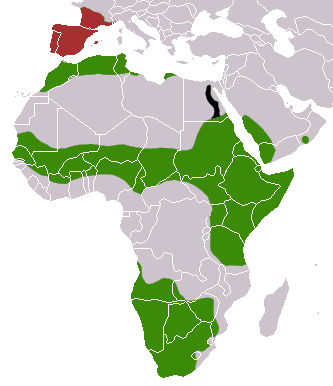
The common genet was brought to the Mediterranean region from the Maghreb as a semi-domestic animal about 1,000 to 1,500 years ago. It spread from the Iberian Peninsula to the Balearic Islands and southern France. It can now be found in almost the whole Iberian peninsula and south-west France.
Threats and conservation
No major threats to common genets are known. In North Africa and some localities in southern Africa, they are hunted for their fur. In Portugal, they get killed in predator traps. On Ibiza, urbanization and development of infrastructure cause loss and fragmentation of habitat.
Genetta genetta is listed on Appendix III of the Bern Convention and in Annex V of the Habitats and Species Directive of the European Union.